

A 41-year-old architect from Manchester sat across from me last spring — hands folded on the desk, a little nervous, the way most of my patients are at the first consultation. He had been losing his hair since his late twenties and had spent years reading forums, watching YouTube videos, and downloading graft calculators from random websites. By the time he found us at MaviEsta, he had convinced himself he needed 6,000 grafts. He actually needed 2,800.
That gap — between what patients think they need and what they actually need — is one of the most common problems I see in this field. And it is not the patient’s fault. The internet is full of vague numbers, conflicting estimates, and clinics that throw out graft counts without ever examining a patient’s scalp. My job in this article is to give you an honest, clinically grounded answer to the question I hear every single week: how many grafts do I need?
I will walk you through every variable — your hair type, your loss pattern, your donor density, your expectations — so that by the time you finish reading this, you will have a realistic picture of what your transplant might involve. Not a promise. A picture.
What Is a Hair Graft?
Before we get into numbers, let us be precise about what we are counting — because this is where a lot of confusion begins.
A hair graft is a naturally occurring unit of follicles taken from your donor area, typically the back and sides of the scalp. Each graft contains between one and four individual hair strands, depending on how your follicles group together. In the medical literature, we call these follicular units.
When I harvest grafts using the FUE (Follicular Unit Extraction) method — which is what we do at MaviEsta — I extract each unit individually using a 0.7mm or 0.8mm punch. The graft is then kept in a preservation solution at a controlled temperature before being placed into the recipient area.
Here is the critical distinction that patients often miss: a graft is not the same as a hair. A single graft might give you one hair, or it might give you four. On average, each graft contains roughly 2.2 to 2.5 hairs. So when a clinic tells you that you need 3,000 grafts, what they are really telling you is that you will receive somewhere in the region of 6,600 to 7,500 individual hair strands.
This matters because some clinics advertise packages by “hairs transplanted” rather than grafts — and the numbers sound more impressive even when the actual graft count is modest. Always ask for the graft number. That is the standard clinical unit.
How Many Hair Grafts Per Square Inch?
This is one of the most important technical questions in hair restoration, and it is one that separates experienced surgeons from those who are simply placing grafts as fast as possible.
In a healthy, unaffected scalp, native hair density runs between 80 and 120 follicular units per square centimetre — or roughly 200 to 300 follicular units per square inch. However, we cannot and do not try to replicate this density in a transplant. If we did, we would run out of donor hair very quickly, and the result would look pluggy rather than natural.
In practice, the density I aim for during a transplant procedure depends on the zone we are working in:
| Zone | Target Graft Density |
| Hairline (front 2 cm) | 35–45 grafts/cm² |
| Mid-scalp | 30–40 grafts/cm² |
| Crown | 25–35 grafts/cm² |
| Temple points | 20–30 grafts/cm² |
The hairline gets the highest density because it is what people see first — in conversation, in photographs, in the mirror. The crown gets slightly less because it covers a larger area and because the hair spirals outward from a central point, meaning lower density still reads as full coverage when the hair lies naturally.
I always tell my patients: the goal is not to restore your 20-year-old scalp. The goal is to create an illusion of fullness that looks completely natural at a normal social distance. These are two different targets, and the second one is achievable.
How Many Grafts Is a Full Head of Hair?
“Full head” is a phrase I hear often, and I always ask patients to show me what they mean — because full head means different things to different people.
If we are talking about complete coverage of a significantly bald scalp — Norwood 5 to 7 — then a truly comprehensive restoration would require somewhere between 5,000 and 8,000 grafts, typically across two sessions. The total surface area of a fully bald scalp can reach 200 cm² or more, and when you multiply that by even a conservative density of 30 grafts per cm², you arrive at numbers that challenge most donor areas.
For more moderate loss — Norwood 3 to 4 — a single session of 2,500 to 3,500 grafts will typically restore a convincing appearance of fullness across the front and mid-scalp. This is the most common range I work in.
But here is what I tell every patient who uses the phrase “full head”: your donor area has a finite supply. Every follicle I take from the back of your scalp is permanently removed. If I use 4,000 grafts on you at 35 and you continue to lose hair into your forties, we need enough donor hair in reserve to address that future loss. A responsible surgeon plans for your entire hair loss trajectory, not just the area that is bald today.
A 38-year-old marketing director from Stockholm came to me two years ago, Norwood 4, wanting everything done in one session. I explained that placing 4,500 grafts now would likely exhaust his donor supply — and if his crown continued to thin (which his family history strongly suggested it would), he would have no options left. We did 2,800 grafts across the front and mid-scalp. He came back fourteen months later for a targeted 1,400-graft session on the crown. The result is excellent. And he still has reserves.
How Many Grafts for a Receding Hairline?
A receding hairline is actually one of the more straightforward scenarios to plan for — largely because the surface area is well defined and the aesthetic impact of restoration is immediate and significant.
For a mild to moderate recession — typically a Norwood 2 to early Norwood 3 — most patients need between 1,200 and 2,000 grafts. This range covers the temporal recession, re-establishes the frontal hairline, and adds density to the zone immediately behind it.
For a more advanced recession — Norwood 3 to 3V (where the vertex is also beginning to thin) — the number climbs to 2,000 to 3,000 grafts to address both the hairline and the early mid-scalp involvement.
The hairline design itself deserves as much attention as the graft count. I spend considerable time at the consultation stage drawing the proposed hairline on the patient’s scalp in a non-permanent marker and photographing it from every angle. The hairline should sit at an anatomically appropriate position for the patient’s age — not where it was at 18, but where it would naturally exist at 35 or 40. A hairline placed too low looks artificial as the patient continues to age. A hairline placed too high looks like an incomplete result. Getting this right requires experience and an honest conversation about what is age-appropriate.
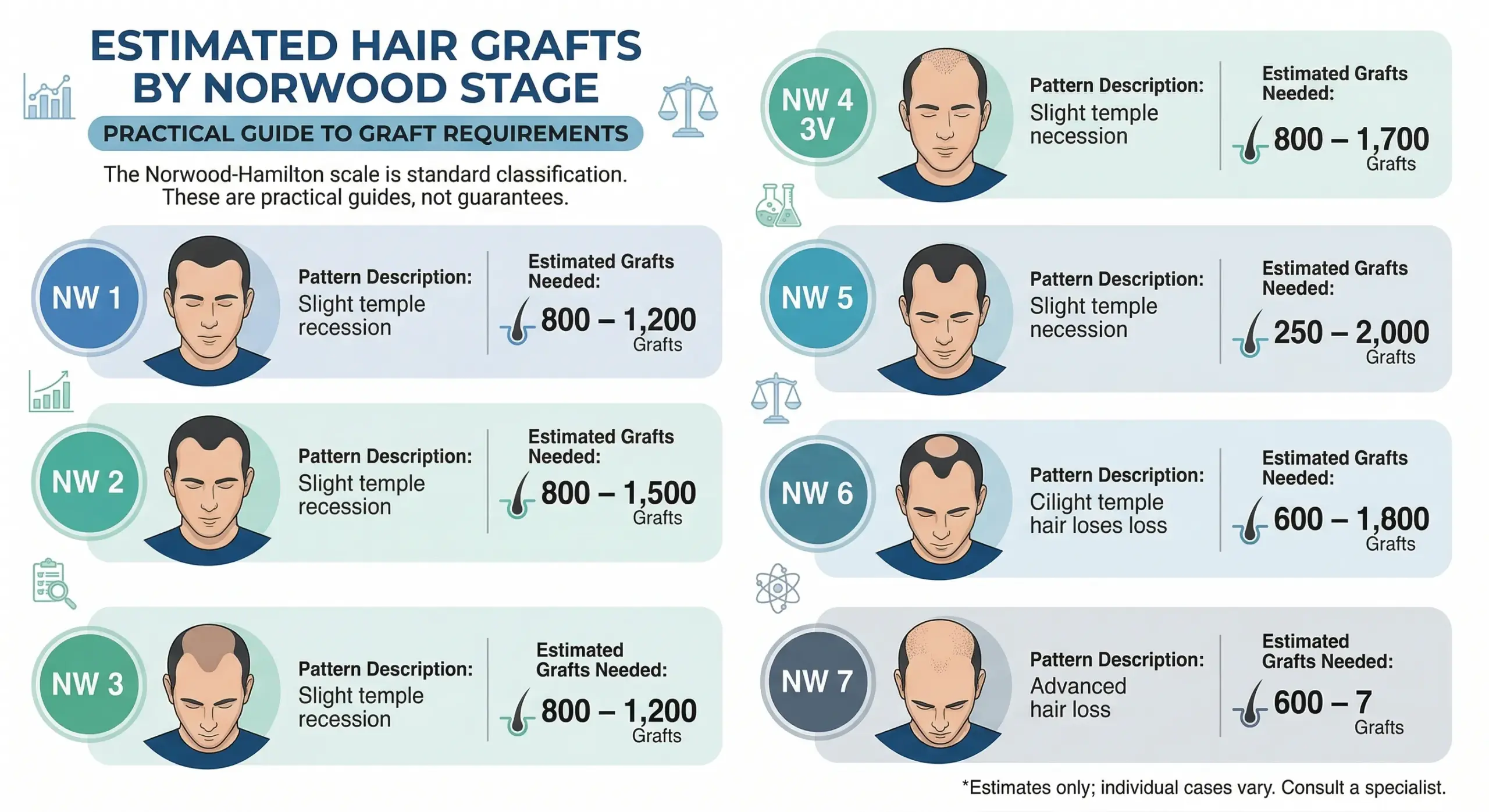
Estimated Grafts by Norwood Stage
The Norwood-Hamilton scale is the standard classification system for male pattern hair loss, and it is the first thing I assess in every new consultation. Here is a practical guide to typical graft requirements at each stage — keeping in mind that these are estimates, not guarantees.
| Norwood Stage | Pattern Description | Estimated Grafts Needed |
| NW 1 | Minimal recession, no treatment needed | 0 |
| NW 2 | Slight temple recession | 800 – 1,200 |
| NW 3 | Defined recession, temples clearly affected | 1,500 – 2,000 |
| NW 3V | Recession + early crown thinning | 2,000 – 2,800 |
| NW 4 | Significant frontal loss + crown thinning | 2,500 – 3,500 |
| NW 5 | Bridge of hair between front and crown narrowing | 3,000 – 4,500 |
| NW 6 | Front and crown merge into one large bald area | 4,000 – 6,000 |
| NW 7 | Only a narrow band of hair on the sides and back | 5,500 – 8,000+ |
A 34-year-old engineer from Dubai came to me last year after consultations at five different clinics — each of which had given him a wildly different graft estimate for his NW4 presentation. The range he had been quoted went from 1,800 to 5,500. I assessed his scalp under dermoscopy, measured his donor density at 78 follicular units per cm², and planned a 3,100-graft procedure. He is now eleven months post-op and the result has exceeded his expectations — achieved with a number well within the middle of that absurd range he had been given.
The variation in estimates he experienced is not unusual. It reflects differences in assessment methodology, surgical philosophy, and — in some cases — commercial incentives. Higher graft counts mean higher prices in many clinics. Another reason to get multiple opinions from qualified surgeons, not salespeople.
How Much Hair Can Be Transplanted in One Session?
The honest answer is: it depends almost entirely on your donor density and the experience of your surgical team.
Most skilled surgeons working at a responsible pace can safely extract and implant between 3,000 and 4,000 grafts in a single session of eight to ten hours. Some cases — patients with exceptionally high donor density and large recipient areas — may extend to 4,500 grafts.
I am cautious about clinics advertising “mega sessions” of 6,000 or 7,000 grafts in a single day. Here is why. Grafts that are extracted but not yet implanted are living tissue. They have a survival window. The longer a graft sits outside the body — even in preservation solution — the lower its survival rate. When you are pushing past 4,000 grafts in a day, the grafts extracted in the morning may have been waiting four or five hours by the time they are placed. That is not where you want to be.
At MaviEsta, I use a system where grafts are extracted in batches and implanted in corresponding batches, keeping the average out-of-body time for each graft under 90 minutes. Graft survival rates matter more than graft counts. A 3,500-graft session with 95% survival will give you a better result than a 5,000-graft session with 70% survival.
If your plan genuinely requires more than 4,000 to 4,500 grafts, the right approach is almost always two separate sessions spaced six to twelve months apart. The donor area recovers, the first transplant matures, and the second session can be planned with full knowledge of how the first result has settled.
What Determines Your Exact Graft Count?
After fifteen years, I can tell you that the number on the consultation form is never arrived at by guesswork. There are six variables I assess for every patient:
- The extent of hair loss. Surface area of the bald or thinning zones, mapped precisely using a calibrated trichoscope.
- Donor density. I measure follicular units per cm² in three separate points across the donor zone using dermoscopy. Average density varies between 60 and 100 FU/cm² in the patients I see. This determines how many grafts are available without over-harvesting.
- Hair calibre. Thicker, coarser hair provides more coverage per graft than fine hair. A patient with thick Mediterranean hair needs fewer grafts for the same optical coverage as a patient with fine Northern European hair.
- Hair curl and wave. Curly or wavy hair covers more surface area per strand. Straight hair lies flat and requires slightly higher density to achieve the same visual fullness.
- Scalp laxity. A relaxed, mobile scalp allows for slightly more aggressive donor harvesting. A tight scalp requires more conservative extraction to prevent visible scarring.
- Future loss trajectory. This is the one that patients most often forget to ask about. If your family history and current loss pattern suggest you will be a Norwood 6 eventually, I need to plan your current procedure with that end-state in mind — not just what is visible today.
Recovery and Growth Timeline
I always tell patients: the hardest part of a hair transplant is not the procedure. It is the waiting.
Here is what the typical timeline looks like after a FUE session at MaviEsta:
Days 1–3: Mild swelling around the forehead and eyes. Donor area looks pink, like a mild sunburn. The recipient area has small scabs around each graft site. This is normal and expected.
Days 4–10: Scabs begin to fall away naturally. Do not pick at them. The transplanted hairs are still anchored but the follicles are settling into their new location.
Week 2–3: Most patients are back in normal clothing with a standard collar shirt. The donor area is no longer visible under normal hair length.
Month 1–3: The transplanted hairs enter a resting phase and shed. Almost all of them. This is called telogen effluvium and it is completely normal — I warn every single patient about it before the procedure because the ones I do not warn tend to panic when it happens. The follicles are not lost. They are resting.
Month 4–6: New growth begins. It is fine and uneven at first. Patience is non-negotiable at this stage.
Month 8–12: The result starts to become visible in a meaningful way. Density fills in, texture normalises, the hairline becomes defined.
Month 12–18: Final result. This is what the transplant actually looks like. Some patients, particularly those with thicker calibre hair, see their full result closer to month 12. Others — especially those with finer hair — need the full eighteen months.
Why a Personalized Plan Matters
I want to say something directly to anyone reading this who has been given a graft count by a clinic without a thorough examination: that number means very little.
A graft count is not a product spec. It is a clinical plan. It needs to be based on measurements of your specific scalp — your donor density, your recipient area, your hair characteristics, your loss trajectory. Any clinic that gives you a number based on photographs alone, or worse, based on your own description of your hair loss, is not giving you a plan. They are giving you a sales figure.
Over the years I have seen patients arrive at MaviEsta after procedures done elsewhere — unhappy not because the grafts failed, but because the plan was wrong from the start. Too many grafts placed in one area and not enough in another. A hairline drawn too aggressively for a patient who was clearly going to continue losing hair. Donor areas over-harvested to the point where the back of the scalp is visibly thin.
These are not complications. They are planning failures. And they are almost entirely preventable with a proper pre-operative consultation.
If you are considering a hair transplant anywhere in the world — at MaviEsta or at any other clinic — I would encourage you to ask for the following before you commit: a trichoscopic donor density assessment, a written graft plan with the rationale explained, and a clear projection of how your plan accounts for future hair loss. If a clinic cannot or will not provide these, keep looking.
Frequently Asked Questions
How many hair grafts do I need?
The honest answer is: it depends on the extent of your hair loss, your donor density, your hair characteristics, and your goals. As a general guide, mild hairline recession requires 1,200 to 2,000 grafts; moderate loss (Norwood 3–4) typically requires 2,500 to 3,500 grafts; advanced loss (Norwood 5–7) may require 4,000 to 8,000 grafts across one or two sessions. The only way to get an accurate number is through a proper clinical assessment of your scalp — not a formula, not a photograph, not a graft calculator from a website.
How many grafts per square inch is normal?
Native scalp density is approximately 200 to 300 follicular units per square inch. In a transplant, we typically aim for 80 to 120 grafts per square inch depending on the zone — higher density at the hairline where visual impact is greatest, and slightly lower at the crown where the hair naturally lies in a spiral that provides optical coverage at lower density.
How many grafts are needed for a full head?
A truly comprehensive restoration across an extensively bald scalp (Norwood 5–7) typically requires 5,000 to 8,000 grafts, usually across two sessions. For moderate loss (Norwood 3–4), a single session of 2,500 to 3,500 grafts will generally achieve a convincing result. The word “full” is subjective — what matters more is whether the result looks natural and proportionate to your age and overall appearance.
How many grafts for a receding hairline?
For mild to moderate recession (Norwood 2 to early 3), most patients need 1,200 to 2,000 grafts to re-establish the hairline and restore the temporal zones. For more significant recession combined with early crown involvement, the number typically rises to 2,000 to 3,000 grafts. The design of the hairline matters as much as the quantity — an anatomically appropriate hairline placed at the right position for your age will look significantly more natural than a hairline drawn based purely on maximising coverage.
Is a hair transplant permanent?
The transplanted follicles themselves are permanent — they are taken from the donor zone at the back of the scalp, which is genetically resistant to DHT (the hormone that causes pattern hair loss). Once successfully implanted, these follicles will continue to grow hair for life. However, a hair transplant does not prevent the natural progression of hair loss in the non-transplanted areas. This is why planning for your future loss trajectory is as important as addressing the loss you have today.
If you are reading this and considering a hair transplant, I genuinely encourage you to book a free consultation — not just with us, but with any reputable clinic. Come prepared with questions. A good surgeon will welcome them. At MaviEsta, my team and I offer a no-obligation assessment where we measure your scalp, map your donor density, and give you a written plan with full clinical reasoning. No pressure, no gimmicks — just an honest conversation about what is possible for you specifically.
Book your free consultation at MaviEsta: maviesta.com